By Dan Edwards, Executive Chef at Rotunda Bar & Restaurant and Joe Boxall, Head of Beverage at Green & Fortune
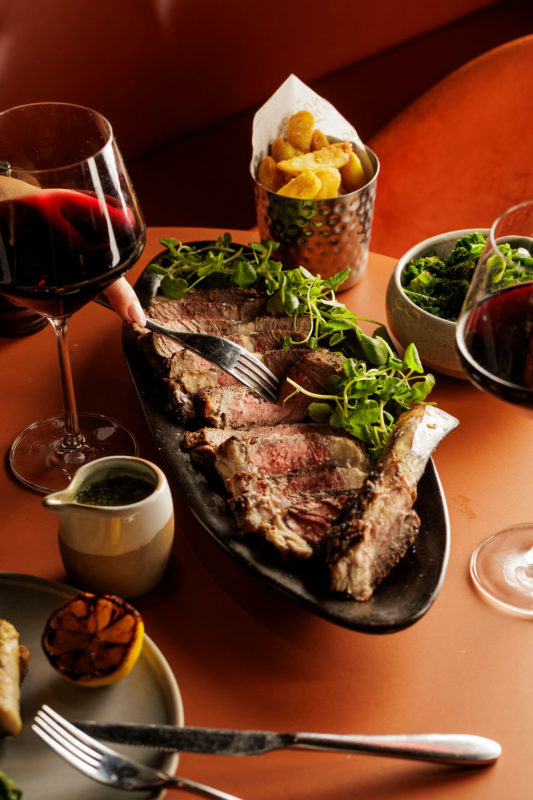
There’s nothing quite like the moment a perfectly cooked steak leaves the pass: the sizzle, the aroma, the first cut through a rosy centre. The right glass of wine takes that moment from good to memorable. Whether you’re settling in for a long dinner at Rotunda or celebrating after a day in King’s Cross, here’s our guide to choosing the wine that does your steak justice.
It all comes down to the cut
Not all steaks are created equal, and neither are the wines that suit them. The main things to consider are fat and tannin. Tannins, the compounds that give red wine its dry, grippy feel, bind to fat and protein, softening on the palate as you eat. A richly marbled cut like ribeye can stand up to a bold, plush red, while a lean, delicate fillet would be overwhelmed by the same wine.
As a rule of thumb, the more fat and flavour in the cut, the more structure and power you want in the glass. Leaner, more tender cuts suit softer, more elegant wines. Your sauce and how you like your steak cooked matter too, but the cut is the best place to start.
Classic steak and red wine pairings
Bavette + Château Cantemerle
Why it works: Bavette is a deeply savoury cut with a distinctive grain, best served medium-rare and sliced. Château Cantemerle, a Fifth Growth Bordeaux, has the elegant structure and fine tannins to match that depth without overpowering it, and its freshness cleanses the palate between bites. Tip: Every Monday we serve a Bavette and Bordeaux special.
Ribeye + Viña Cobos Felino Malbec
Why it works: Ribeye is rich, well-marbled and full of flavour. Felino’s ripe dark fruit and velvety texture meet that richness head-on, while its structure cuts through the fat so every bite feels as satisfying as the first.
Sirloin + Sidewood Shiraz
Why it works: Sirloin has a firm, beefy bite and a good fat cap. Sidewood’s Adelaide Hills Shiraz brings dark fruit and peppery spice that echo the char of the grill, and the fat in the steak softens its tannins into something silky.
Rump + Viña Elena Familia Pacheco Organic Monastrell
Why it works: Rump is robust and full of flavour. Monastrell is a savoury, earthy red with dark fruit and a touch of spice, so it matches the meaty depth of the cut. It’s also a good choice if you’d like an organic bottle.
Can you have white wine with steak?
Yes, you can. I’d serve leaner cuts like fillet with a creamy Semillon Chardonnay such as Saddle Creek, whose weight stands up to a béarnaise or peppercorn sauce. For something fresher, try Nostros Reserva Riesling, Viña Temprana Viura or Blank Bottle Autumn Equinox, whose crisp acidity and texture cut through the richness of the beef. And if you’d like to celebrate, Roebuck Estates Rare Expressions No. 96, a rich, toasty English sparkling wine, is a brilliant match for a tender steak.
Frequently asked questions
What is the ideal temperature to serve wine with steak?
Serve red wine slightly cooler than room temperature, at around 16–18°C. Too warm and the alcohol dominates; too cool and the flavours are muted. Whites should be well chilled, and sparkling wine colder still.
Should I decant the wine before serving with steak?
For young, full-bodied reds like Malbec, Shiraz or Bordeaux, yes. Decanting for 30–60 minutes softens the tannins and opens up the aromas. Whites and sparkling wines don’t need it.
Is there a red wine that goes with all cuts of steak?
No single wine is perfect for every cut, but a Cabernet-led Bordeaux like Château Cantemerle is the safest all-rounder. It has enough structure for richer cuts without being too heavy for leaner ones.